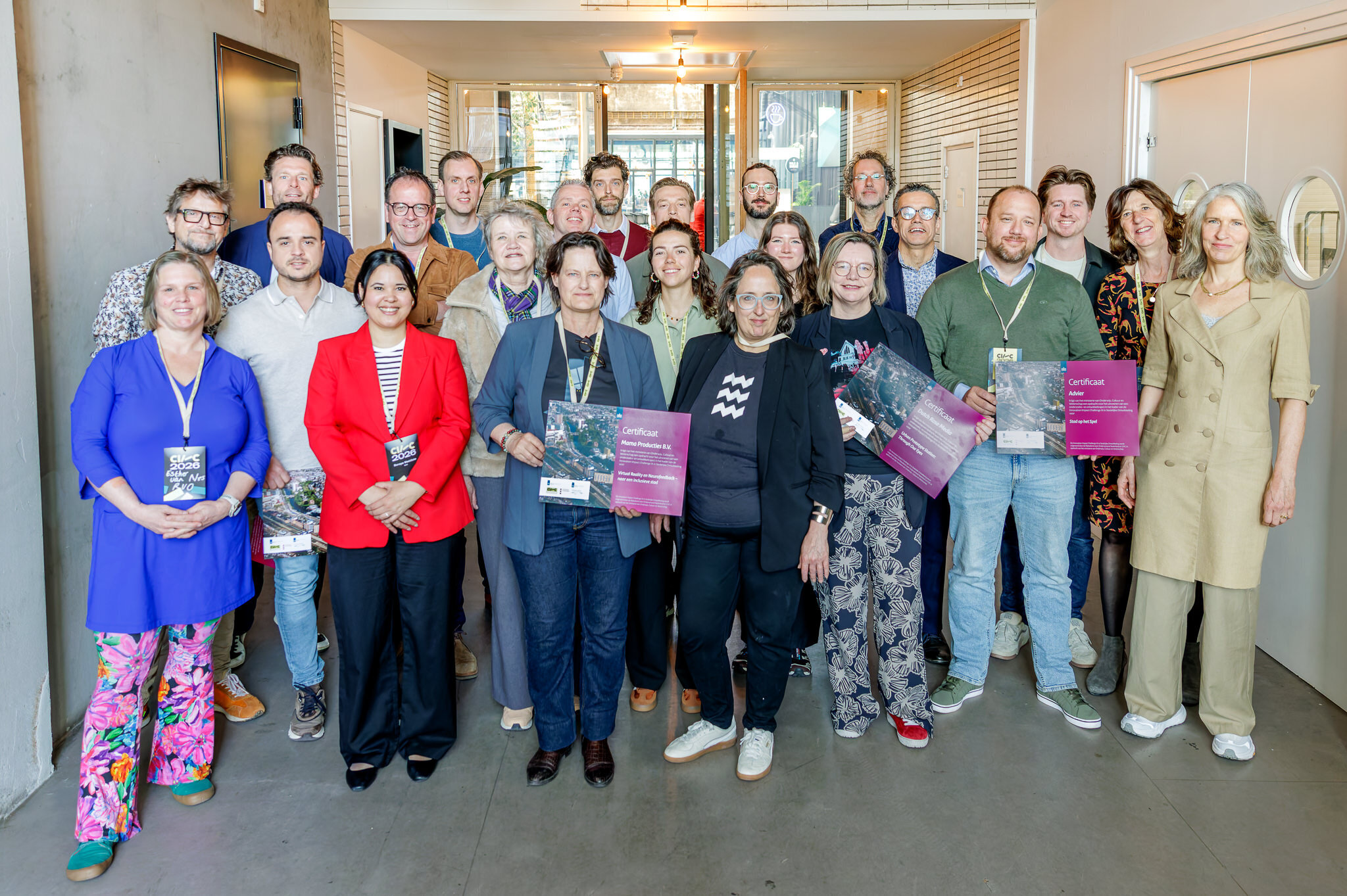
After the first phase, 10 projects have been selected for the next step within the Innovation Impact Challenge: IX in urban development. In this second phase, the selected parties further develop their ideas into a tested prototype.
The challenge focuses on how Immersive Experiences (IX) can contribute to solving complex urban issues, such as (affordable) housing, sustainability, climate adaptation and accessibility.
Immersive Experiences (IX) are experiences that immerse users in an interactive and lifelike digital environment. Think of virtual reality, 360° video, augmented reality, interactive animations and games. With these experiences, scenarios and the impact of choices in the physical living environment are made clear.
From feasibility study to tested prototype
Earlier, 17 projects were selected for phase 1, in which entrepreneurs conducted a feasibility study. Based on these results, 10 projects have now been selected for phase 2.
In this phase, the entrepreneurs focus on developing and testing a working prototype.
The Ministry of Education, Culture and Science (OCW), CIIIC, RVO and the municipalities of Amsterdam and Almere challenged entrepreneurs to develop innovative IX products and services that contribute to a future-proof urban environment. The solutions demonstrate how IX helps municipalities and other parties involved to make faster and better-informed decisions, as the coherence and impact of different solutions are made more visible and tangible.
The submitted projects fall within two themes:
- Theme 1: Suitable, innovative and future-proof IX solutions that approach urban challenges in an integrated way
- Theme 2: Preventing and reducing the negative consequences of urban development for those affected
With these 10 projects, the Innovation Impact Challenge takes a further step in applying immersive experiences within urban development. In the coming period, the selected parties will develop their solutions further and test them in practice. The start of this phase was celebrated during CIIIC 2026 on 16 April at the Werkspoorkathedraal in Utrecht, together with the selected entrepreneurs and in the presence of DG Youssef Louakili.
The 10 selected projects
Theme 1: Integrated IX solutions for urban challenges
MapGear B.V. – TransitieTwin3D
Municipalities face major spatial challenges such as housing construction, the energy transition and the redesign of streets. For residents, these plans are often hard to understand, which leads to uncertainty, resistance and delay. Existing participation solutions are often expensive, project-specific bespoke work and poorly linked to municipal data. TransitieTwin3D takes a different approach. It is a scalable participation platform that automatically translates plans into understandable 3D images of the neighbourhood. Residents explore and discuss scenarios together, via an interactive table and later online, and respond directly to specific locations. Phase 1 proved that it works; phase 2 develops it into a widely applicable solution.
Stipo – Placemaking Immersive
STIPO and ORB Amsterdam are jointly developing Placemaking Immersive. It digitises proven participation methods via IX for complex urban challenges. The core is the innovative 'incremental co-creation' methodology: stakeholders share a single headset in a 'relay form' and build step by step on each other's visual input. Instead of a single static projection, the senses (light, sound, interactive elements, smell and touch) are stimulated sequentially. This approach forces dialogue and promotes agreement by visualising visions directly on site.
LOS Ruimte – Participate-360
This project focuses on the further development of a digital platform that supports the design, calculation of ecosystem services and 3D visualisation of public space. By linking and automating existing systems, a way of working is created in which spatial choices can be made faster, better substantiated and more clearly.
Witteveen+Bos – IX stakeholder participation framework
This project develops a digital IX framework to make plans more transparent and understandable. Residents can view variants, understand choices and respond easily. Governments gain better insight, more support and more strongly substantiated decisions.
Advier B.V. – City at Stake
An interactive, immersive game experience in which policy teams experience how today's choices play out towards 2050. The project translates complex policy issues into concrete, human scenarios and stimulates cross-domain thinking.
Theme 2: Reducing the negative effects of urban development
Webbio B.V. – City in View
A participatory Digital Twin as a SaaS solution for municipalities. The platform integrates spatial data and policy information into interactive 3D visualisations, with the aim of improving citizen participation and making decision-making more transparent.
Siekerman Technology B.V. – AR Insight
A platform that makes it easy to develop AR applications for urban development. Residents can view future construction projects on site through augmented reality.
Common City Development B.V. – PublicTwin
A platform that enables large-scale, inclusive citizen participation via mobile tools, 3D environments and AI analysis. It translates input from residents into usable insights for decision-making.
Mama Producties B.V. – Virtual Reality and Neurofeedback
A measuring instrument that combines VR with neurofeedback and eye-tracking to provide insight into how people experience urban environments. This helps in designing inclusive and more pleasant living environments.
Dutch Rose Media – Urban Prototype Station: Through Our Eyes
A platform that makes urban plans accessible through AR and VR. With tools for inspiration, design and preview, it supports better and more inclusive decision-making.